
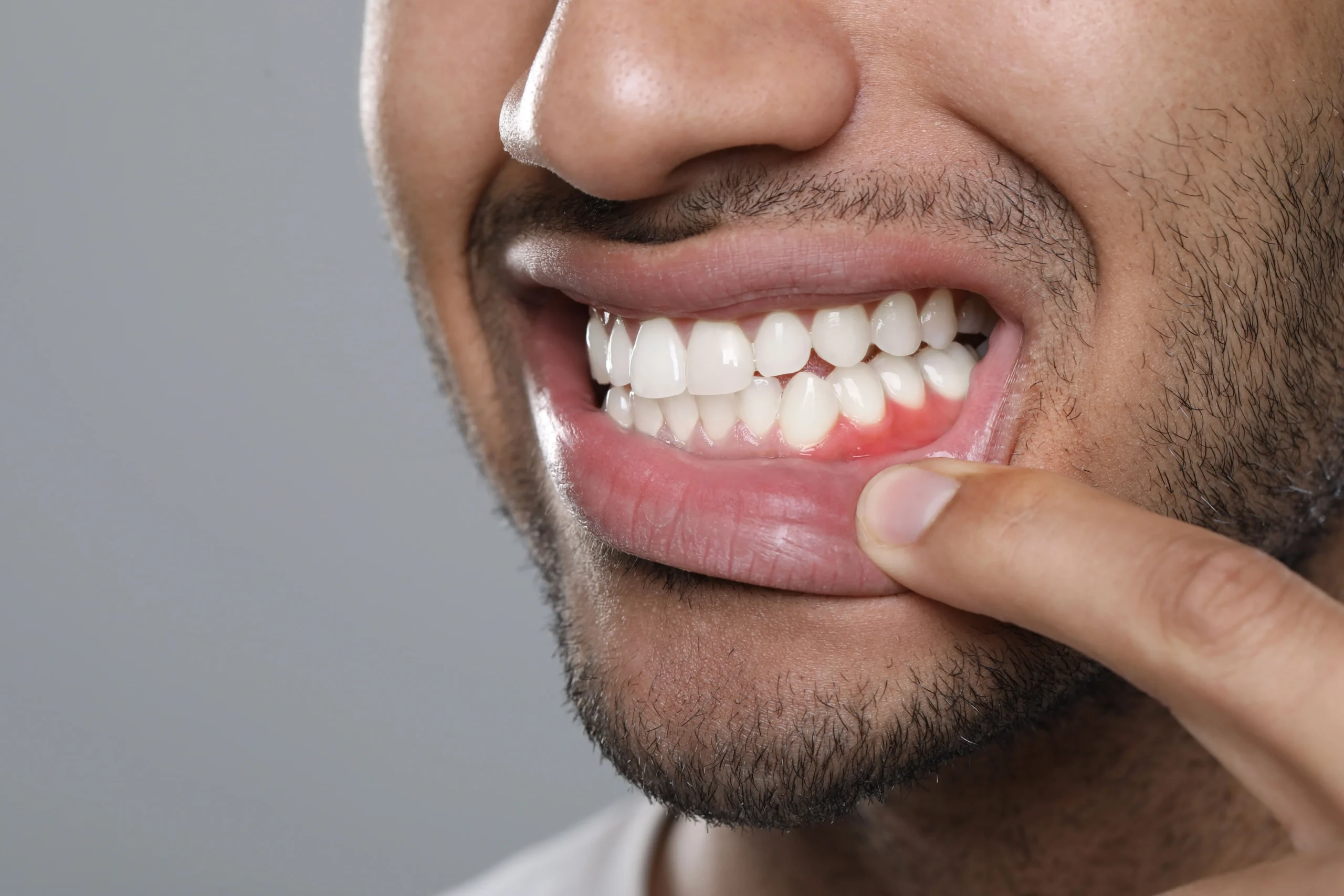
Frequent bleeding, inflammation, receding gums, dental mobility, or a diagnosis of periodontitis may indicate that tissues that support your teeth need a specialized evaluation.
In Clínica Dental Champsaur, Dr. Angela María Prieto, a specialist in Periodontics, evaluates the health of the gums, the support of the teeth and bone to establish a diagnosis and determine the appropriate treatment according to each case.
Do your gums bleed, have they receded, or have you already been diagnosed with periodontal disease?
It allows for the identification of inflammation, bleeding, and periodontal pockets.
It evaluates the tissues and bone that support your teeth.
From gingivitis to periodontitis, recession, and loss of support.
Follow-up according to diagnosis, response to treatment and risk factors.
Periodontics is the dental specialty dedicated to preventing, diagnosing and treating diseases that affect the gums and tissues that sustain the teeth, including bone.
It also evaluates problems such as gum recession, periodontal bags, loss of support, certain bone defects and tissue alterations around teeth and implants.
Treatment depends on the diagnosis and extent of the disease.
The periodontist is a specialist in gums and supporting tissues of the teeth.
It may be advisable to carry out a periodontal evaluation if you have:
Bleeding, mobility, recession, or bad breath are signs that need evaluation, but do not by themselves constitute a diagnosis of periodontitis.
![]()
Frequent bleeding can be a sign of gingival inflammation and is common in conditions such as gingivitis and periodontitis.
However, not all people who have bleeding have the same disease.
During the periodontal evaluation, gums, plaque and calculus, pocket depth of the pockets, bleeding into the pockets, and other findings are reviewed to determine the cause.
If your gums bleed frequently, you should evaluate the cause before assuming that you only need a tooth cleaning.
Although both affect gums, gingivitis and periodontitis are not the same.
Gingivitis is an inflammation of the gums without loss of tissues that hold the teeth.
You may submit:
It can be reversed when the bacterial plaque is properly controlled and the professional treatment indicated.
Gingivitis does not necessarily become periodontitis. It may progress in certain people when inflammation and risk factors persist, but it is not an inevitable evolution.
Periodontitis affects tissues that support teeth and may cause:
The disease can be treated and controlled, but the missing supporting tissues do not recover simply by eliminating inflammation.
Certain defects may be candidates for regenerative procedures.
The aim of the evaluation is to determine whether periodontal disease exists, its extent and severity, and what factors may influence its evolution.
It may include:
-Medical and dental history.
-Periodontal history.
-Hygienic habits.
-Risk factors.
-State of gums.
-Plate presence and calculus.
-Recessions.
-Dental mobility.
-Migrated or separated teeth.
-State of implants when appropriate.
A periodontal probe allows to measure the space between the tooth and gum.
These measurements help to identify periodontal bags and know the state of the tissues around each tooth.
You can also register:
-Bleeding to the probe.
-Lost of insertion.
-Recessions.
-Mobility.
-Commitment of certain areas between the roots.
X-rays can be used to assess the bone level around the teeth.
Not all patients need the same studies.
The type of X-ray is selected according to clinical findings, history and needs of each case.
Periodontal treatment depends on diagnosis, disease extension, loss of support and tissue response.
It may include non-surgical treatment, surgical procedures, regeneration and maintenance.
Root scraping and straightening, commonly known as deep cleaning, is one of the main non-surgical treatments for patients with periodontitis.
The procedure seeks to remove plaque and calculation of dental and root surfaces, especially in areas below the gum line.
Depending on the affected areas, it can be done by sector and requires more than one session.
Some people seek this treatment using terms such as “dental curettage” or “periodontal curettage”. The technique that each patient really needs should be defined after a periodontal evaluation.
Periodontal bags are spaces that form between the tooth and gum when there is loss of support.
When deep, they can hinder hygiene and favor plaque accumulation and calculus under the gum.
Treatment may begin with non-surgical periodontal therapy.
If deep pockets or hard-to-reach areas persist after reassessment, other alternatives, including periodontal surgery, may be considered in selected cases.
Gingival recession occurs when the gum moves and exposes a part of the dental root.
You may be associated with:
First it is necessary to evaluate the cause, anatomy of the area and periodontal condition.
Depending on the characteristics of the case, root coverage or gum graft procedures may be considered.
Not all recessions can be treated in the same way, nor can full root coverage be guaranteed.
Not all patients with periodontitis need surgery.
Treatment usually begins with hygiene control and non-surgical periodontal treatment when indicated.
The response is then evaluated.
If deep pockets, bone defects or areas that cannot be properly managed through non-surgical treatment continue, periodontal surgery may be assessed.
According to the diagnosis, procedures may include:
Learn more about What is periodontal surgery?
Periodontal disease can cause loss of bone and other tissues that support teeth.
In certain defects, regenerative treatment may be considered to attempt to recover some of the lost tissue.
Dr. Angela María Prieto directs her practice to Periodontics, bone regeneration and dental implants, so this area is part of the specialized care available at Clínica Dental Champsaur.
Regeneration may be relevant in:
The ability to regenerate tissue depends on the shape, location and extent of the defect.
Not all bone loss can be recovered by a regenerative procedure.
It is a preventive or maintenance measure used when the patient does not have a periodontal condition requiring treatment under the gum.
It can be part of General Dentistry care.
Radicular scraping and straightening is a therapeutic treatment indicated when periodontal disease exists.
Work is done under the gum line and on root surfaces to remove deposits associated with the disease.
Therefore, preventive cleaning does not replace periodontal treatment when periodontitis exists.
Each plan depends on the diagnosis, but periodontal treatment is usually staged.

Gums, teeth, supporting bone, hygiene and risk factors are studied.

It is determined whether there is periodontal health, gingivitis, periodontitis or other alteration.
When periodontitis exists, its extent, severity and prognosis are also evaluated.

The patient receives individualised instructions to improve his hygiene and reduce the accumulation of biofilm.
Daily care is an essential part of treatment.

When indicated, radicular scraping and straightening may be done to treat the affected areas.

If certain areas do not respond adequately, it can be assessed:
– Periodontal surgery.
– Reroot canalion of bags.
– Gingival grafts.
– Periodontal regeneration.
– Bone regeneration.

When the disease is stabilized, a follow-up stage begins to control the health of gums, teeth, and supporting tissues.

After initial treatment it is re-checked:
-Bleeding.
-Inflammation.
-Deepness of bags.
-Hygiene.
-Tissue response.
-Areas that remain active.

Treatment does not necessarily end at the end of root scraping and straightening.
After allowing tissues to respond to treatment, periodontal reassessment is performed.
They are reviewed again:
From this evaluation it is determined whether the response is adequate or whether any area needs additional treatment.
The number of appointments and stages is not the same for all patients. It depends on the extent of the disease, the number of affected areas and the response to treatment.
Maintenance is an essential part of periodontitis control.
Even if the disease stabilizes, it is necessary to watch that it does not progress again.
Maintenance may include:
The health of gums and bone is important both before and after dental implants.
From the periodontal area can be evaluated:
Having had periodontitis does not automatically mean that a person cannot receive implants.
First it is necessary to evaluate and control periodontal disease and to study factors such as bone, gum, hygiene and individual risk.
The frequency should not be the same for all patients.
It depends on factors such as:
After controlling periodontal disease, a maintenance program is established according to the diagnosis and needs of each patient.

If you have gum bleeding, swelling, recession, dental mobility, or have already received a diagnosis of gingivitis or periodontitis, a periodontal evaluation allows you to know the state of your gums and the support of your teeth.
Dr. Angela Maria Prieto will evaluate your case to determine what treatment you need and establish a control and maintenance plan according to your diagnosis.
The periodontist is the specialist in charge of diagnosing and treating diseases of the gums and tissues that sustain the teeth.
In Clínica Dental Champsaur, the periodontics area is in charge of Dr. Angela Maria Prieto.
Bleeding may indicate inflammation and is common in gingivitis and periodontitis.
However, it may also have other causes.
If it occurs frequently, gums should be evaluated to determine the origin and appropriate treatment.
Frequent bleeding should not be considered normal.
It may indicate inflammation of the gums and deserves evaluation if it persists.
No.
Gingivitis may progress to periodontitis in certain patients if inflammation and risk factors persist, but this evolution is not inevitable.
Yes.
Treatment seeks to control inflammation, stabilize the disease, and reduce the risk of continued loss of supportive tissues.
Post-maintenance is an important part of long-term control.
It is the common name used for root scraping and straightening.
Unlike preventive cleaning, this treatment works under the gum and on root surfaces to remove plaque and calculus associated with periodontal disease.
The term “dental cure” is often used in a popular way to refer to deep periodontal cleaning treatments.
However, the indicated treatment should be clinically defined after evaluation of gums and periodontal bags.
In patients with periodontitis, one of the main non-surgical procedures is root scraping and straightening.
No.
Preventive dental cleaning is mainly aimed at maintaining oral health.
Deep or scraping and root straightening is a periodontal treatment that is performed when there is a clinical indication.
It can cause tenderness or discomfort.
Local anesthesia may be used when necessary to maintain patient comfort during the procedure
Advanced periodontitis can result in loss of bone and tissues that sustain teeth, causing mobility or changes in position.
There are also other causes, so a mobile tooth needs evaluation before determining its prognosis.
Not always.
Certain defects may be candidates for periodontal or bone regeneration procedures, but not all bone loss can recover.
The possibility depends on the anatomy, extension and characteristics of the defect
It depends on your diagnosis, initial severity, risk factors and response to treatment.
Therefore, the interval is set individually after stabilising the disease.
Agenda tu cita
¡Contáctanos hoy!